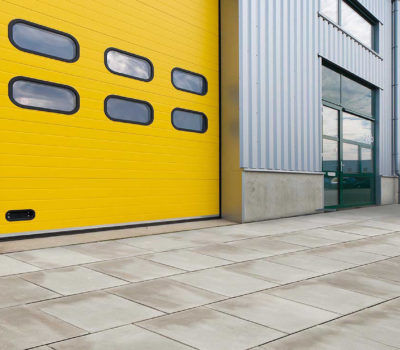
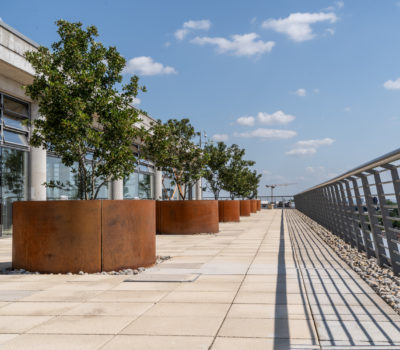
AirPave® a revolutionary yet affordable development in photocatalytic concrete to facilitate the reduction of pollution in the urban environment.
Photocatalysis is a well-known phenomenon and most life on earth depends on photocatalytic reactions such as photosynthesis. There are a number of materials that display photocatalytic behaviour and are able to oxidise and breakdown pollutants.
Titanium dioxide is one such material.
Advances in nanotechnology have resulted in the production of photocatalytic cement such as TioCem® which incorporates titanium dioxide. The use of photocatalytic concrete has been proven to improve both external appearance and the environment, through self-cleaning and reducing pollution in the surrounding air (1)
The principle of exploiting photocatalysis in cement-based products is now well established and the performance of photocatalytic concrete surfaces has been proven both in laboratory and in full-scale practical trials and applications.
At present, many UK cities and conurbations clearly exceed the limits for air-borne pollution originally imposed by the EU Air-quality Directive (2) and now augmented with additional UK targets through domestic regulations for fine particulate matter (PM2.5).
Pollution from exhaust gasses is one of the major problems facing cities and other built-up areas. Pollutants such as nitrogen oxide (NOx) are health hazards and increase the risk of respiratory infections and can impair breathing.
Oakdale’s unique EcoPress®Technology can utilise Low Embodied Carbon Concrete (LECC) and TioCem® in an innovative and cost efficient manner. The result is AirPave® a new Sustainable & Affordable TX Active® environmental product which combines all the sustainable low carbon qualities of Centurion™, Bedale® or Tactile paving with the added benefit of also improving air quality. DBT® production methodology can facilitate the use of photocatalytic concrete in BS Heavy Duty Kerbs, providing an affordable LECC Heavy Duty Kerb that also reduces air pollution in the urban environment.
The concrete surface decomposes harmful nitrogen oxides (NOx) by means of photocatalysis
Natural daylight is sufficient for initiating the photocatalytic degradation of harmful NOx into harmless NO3 which is then washed away by rainfall
The photocatalytic reaction does not diminish with time and is continuous
In tests, 40% of NOx was immediately oxidized into NO3
TioCem® cement complies with the European standard for cements and durability properties are the same as standard cement
Ecologically clean and neither toxic nor hazardous to health (3)
TX Active® is a quality label for the photocatalytic activity of building materials which is widely used throughout Europe.
Manufactured in accordance and compliant to all relevant sections of BS EN 1339:2003 and BS EN 1340:2003
EU Directive 2008/50/EC on ambient air quality and cleaner air for Europe, Annex X1, 2008
LEE, J, MAHENDRA, Sand ALVAREZ, P.J.J. Potential environmental and human health impacts of nanomaterials used in construction industry, in Nanotechnology in Construction – NICOM3, BARTOS, PJ. M., Z., NEMECEK, J., SMILAUER, V, and ZEMAN, J. (Eds.), Proceedings of Int’l Symposium, Prague 31 May to 2 June 2009; Springer-Verlag, Berlin, 2009, ISBN 978-3642-00979-2, pp1-1
Reaction Process
How TioCem® reduces Nox
The velocity of the photocatalytic oxidation depends on the light intensity and air flow.
A durable, hardwearing and functional utility paving flag manufactured from dense hydraulically wet-pressed high performance Low Embodied Carbon Concrete (LECC).
Suitable for both domestic and commercial applications.
Available in plain or riven surface finishes and a variety of colours and sizes.
Perfect for pathways, hard standings and utility areas.
Commercial projects usually (but not exclusively) require our BS Bedale® alternative manufactured in accordance and compliant to all relevant sections of BS EN 1339:2003.
Premium quality, contemporary and stylish textured paving, suitable for both domestic and commercial applications.
A signature product with a highly desirable yet functional textured non-slip surface.
Manufactured utilising high performance Low Embodied Carbon Concrete (LECC) in conjunction with our unique EcoPress®Technology, a premium hydraulically wet-pressed textured paving with the added benefit of an extremely low carbon footprint, at no extra cost.
Manufactured in accordance and compliant to all relevant sections of BS EN 1339:2003.
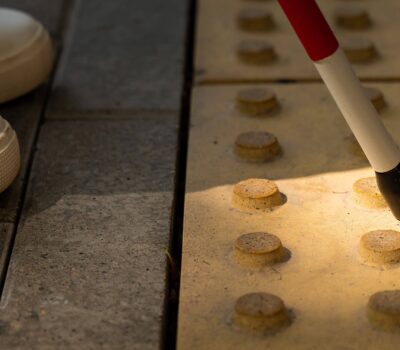
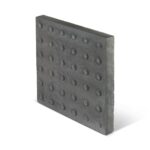
Durable hardwearing hydraulically wet-pressed tactile safety paving is specifically designed to assist visually impaired pedestrians.
Available in a range of colours and sizes to suit the Department of Transport’s guidelines on the use of tactile paving surfaces.
Manufactured utilising superior dense Low Embodied Carbon Concrete (LECC) in conjunction with our unique EcoPress®Technology we are able to provide sustainable tactile paving fully compliant to all relevant sections of BS EN 1339:2003 with the added benefit of an extremely low carbon footprint, at no extra cost.
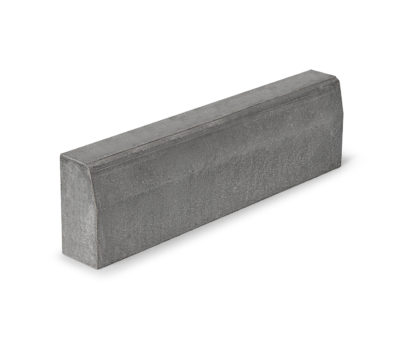
A groundbreaking range of sustainable British Standard (BS) Heavy Duty Kerbs, Channels and Edgings to complement our paving.
Utilising Low Embodied Carbon Concrete (LECC) in conjunction with our unique DBT®Technology we are able to provide BS Heavy Duty Kerbs fully compliant to BS EN 1340:2003 with a carbon footprint up to 24% lower than similar alternatives on the market.